Field note
API Penetration Testing That Finds BOLA With ID Swaps: OWASP Aligned
Practitioner workflow for API penetration testing aligned to OWASP API Top 10. Lab-ready setup, cross-user ID tests, GraphQL/gRPC checks, and manual...
Practitioner workflow for API penetration testing aligned to OWASP API Top 10. Lab-ready setup, cross-user ID tests, GraphQL/gRPC checks, and manual...
API penetration testing simulates real attacks against an API to uncover exploitable authentication, authorization, injection, SSRF, and business-logic flaws before an attacker finds them first. Authorization failures, particularly broken object-level authorization (BOLA), rank as the top risk category in the OWASP API Security Top 10. The strongest engagements pair automated discovery with hands-on manual verification, and success looks like a reproducible proof of concept tied to clear remediation steps, not a scanner printout.
TL;DR:
- API penetration tests should be conducted before production releases, during compliance audits, before third-party onboarding, and after security incidents.
- Building a comprehensive endpoint inventory requires both passive discovery, such as spec analysis and JavaScript scraping, and active brute forcing and fuzzing techniques.
- Confirming vulnerabilities like broken object-level authorization demands cross-user request comparisons with raw proof, not scanner alerts alone.
- Testing should include injection across REST and GraphQL, rate limits, business logic abuses, and SSRF, especially in cloud environments with internal metadata endpoints.
- Manual verification remains essential for validating multi-step exploits and reducing false positives identified by automated tools.
Four moments consistently trigger a test: before a production release, to satisfy a compliance mandate like PCI DSS or SOC 2, before onboarding a third-party integration partner, and after a suspected incident. Each scenario shapes scope differently, so define it before the engagement starts.
A workable scope checklist covers, especially when handling sensitive data such as health records, as outlined in the security questionnaire for healthcare software:
Most commercial engagements use a gray-box model. Testers get partial documentation and at least one valid credential, which mirrors what a real attacker with a leaked token or compromised account would have. Safe-mode controls, including dry-run flags, request throttling, and a rollback plan for test data, keep aggressive checks from taking down a production system mid-test.
Preparation determines how much of the engagement window gets spent testing versus fumbling with setup. Gather every specification artifact you can find first: OpenAPI/Swagger files, Postman collections, and GraphQL SDL schemas. Import all of it into your tooling before touching a single endpoint.
Pro Tip: Name your test identities something obvious, like user_a and user_b, in every saved request. Six hours into a test, you will not remember which token belonged to which account, and mislabeled evidence undermines an otherwise solid finding.
An endpoint inventory built only from official documentation is almost always incomplete. Passive reconnaissance fills the gaps: pull OpenAPI specs, scan public documentation, extract routes from client-side JavaScript bundles, check the Wayback Machine for retired API versions, and run Git dorking against public repositories for leaked internal endpoints.
Active methods do the rest of the work:
/v1/, /internal/, /admin/)The OWASP Web Security Testing Guide's API reconnaissance chapter treats this phase as foundational. For good reason, undocumented or deprecated endpoints frequently run older code with weaker access controls than the current version. Keep a running inventory across every API version you find, and flag anything that looks like a shadow endpoint the current team may not even know exists.
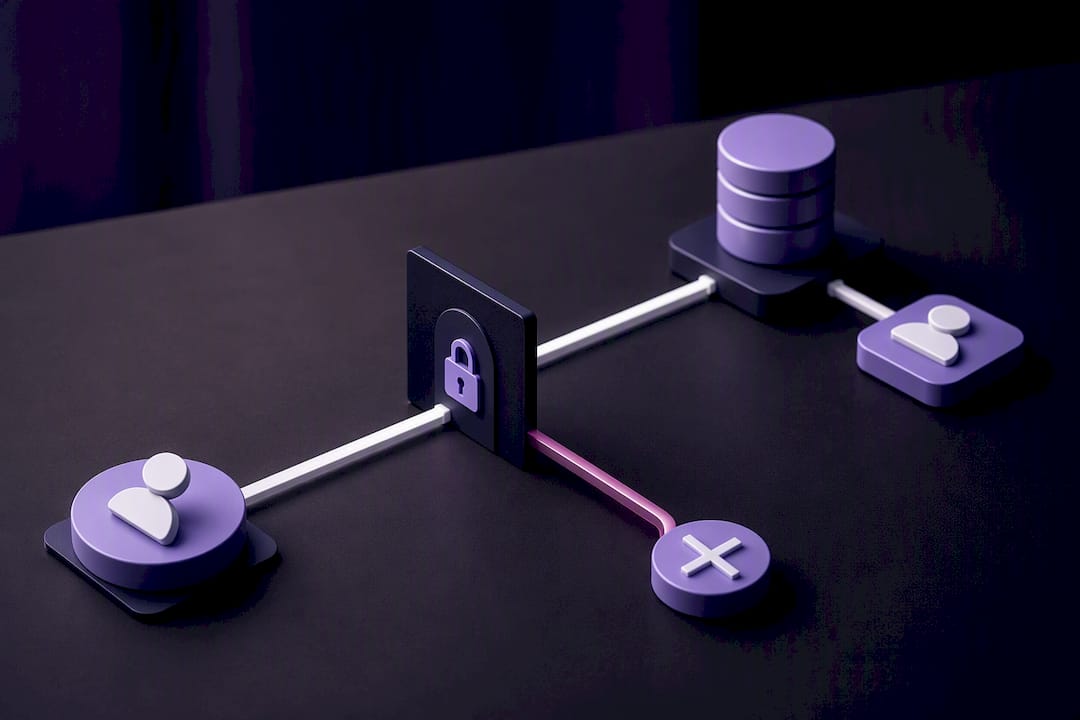
Authentication checks come first but rarely produce the highest-impact findings. Look at token lifecycle handling (does a logged-out token still work?), JWT algorithm confusion and kid header manipulation, brute-force resistance on login endpoints, and whether MFA can be bypassed by hitting a legacy endpoint directly.
Authorization testing is where the real damage tends to surface. Three of the top five risk categories in the current OWASP API Security Top 10 relate directly to access control failures, not authentication weaknesses, which is why this phase deserves more engagement time than most testers give it.
A practical sequence looks like this:
user_a, capture a request that returns object data (an invoice, a profile, an order), and note the object ID.user_b, replay the identical request but swap in user_a's object ID, and check whether the response returns data it should not."role": "admin") to a legitimate update request.Cross-user testing is what turns a suspicion into evidence. A single successful ID swap, captured as a raw HTTP pair with both requests side by side, is far more convincing to a development team than a narrative description of "potential BOLA." That pairing, not a vulnerability scanner's flag, is what separates a confirmed finding from a false positive.
Injection risk in APIs hides in more places than a typical web form. Check the URL path itself, custom headers, the JSON body at every nesting level, and any XML payloads still accepted for legacy compatibility.
sqlmap against parameters that accept raw query fragments.Remediation almost always traces back to the same three fixes: parameterized queries instead of string concatenation, schema-driven input validation at the API gateway, and response minimization so the API only returns what the client actually needs.
Some of the costliest API flaws never trip a traditional vulnerability scanner because nothing is technically "broken." The logic just was not designed to resist abuse.
Pro Tip: Test SSRF with an internal cloud metadata address (169.254.169.254) whenever the target runs in a cloud environment. It is one of the fastest ways to prove real business impact from a flaw that looks minor on paper.
Short-term fixes are usually rate limits, strict URL allowlists, and request timeouts. Long-term fixes mean redesigning the flow so the business logic itself does not depend on client-side trust.
GraphQL and gRPC carry attack surfaces a REST-focused checklist will miss entirely.
The OWASP WSTG chapter on GraphQL testing covers resolver-level injection paths in more depth than most general API guides, and it is worth a direct read if GraphQL is a meaningful part of the target's surface.
Automated frameworks earn their place in the workflow, but only for what they are actually good at. Tools built around the OWASP API Security Testing Framework (ASTF) run structured test suites mapped to the OWASP Top 10, cover GraphQL, gRPC, and mutual TLS scenarios, and have been validated against intentionally vulnerable targets like crAPI and VAmPI.
What automation reliably misses is attacker-path chaining: the multi-step sequence where a low-severity information leak in one endpoint becomes the key to exploiting authorization on a completely different one. Automated scanners also cannot safely judge whether a state-changing request actually caused business harm, which is exactly the kind of verification a human tester has to perform by hand.
Manual verification exists specifically to cut false positives and validate the exploit chains automation cannot reason through on its own, which is the core logic behind Earthshaker Security's hybrid approach to API and endpoint testing.
A report that just lists CVSS scores wastes the engagement. Development teams need enough context to reproduce, fix, and verify the fix without a follow-up call.
Fix priority should follow risk, not convenience: authorization and data-exposure flaws close first, injection and business-logic issues next, and cosmetic header hardening last.
| Finding Category | Typical Priority | Fix Type |
|---|---|---|
| BOLA / broken authorization | Critical, fix first | Long-term code change |
| Sensitive data exposure | Critical, fix first | Response schema change |
| Injection (SQL/NoSQL/XML) | High | Parameterized queries |
| Rate limiting / resource abuse | Medium | Gateway config, short-term |
| Missing security headers | Low | Config change |
Most of the value in an API pentest comes from the findings a client can actually verify and act on, not the length of the report. We steer away from noisy checks that flag theoretical issues no attacker would chain into anything real, and instead reproduce the exact path an attacker would take. A typical pattern: swap an object ID between two authenticated test accounts, confirm the leak with a raw request pair, then hand the client a fix they can ship the same day.
— caleb
Some API and endpoint testing services combine fast automated discovery with hand-verified exploitation, so every finding in a report is a confirmed flaw with a reproducible proof of concept, not scanner noise you have to triage yourself. Reports are written for both your engineering team and your non-technical stakeholders, and every engagement includes a retest to confirm the fix actually closed the gap.
Engagements come in a few shapes depending on how much ground you need covered. The Starter tier runs $1,000 as a one-off test, suited to a single API or a pre-release check. Teams that need continuous coverage typically move to the Retainer plan at $795 per month, and larger or custom scopes are priced at $450 per day. Full details on what each service includes, from API testing to configuration audits, are on the services page. Start by reviewing your pricing options and requesting a scope conversation with a tester directly, not a sales rep.
Testers exercise GET, POST, PUT, PATCH, and DELETE against every endpoint in scope, since authorization flaws often appear on one method but not another. A GET request might correctly block cross-user access while the PATCH endpoint for the same resource does not, which is why each method gets tested independently rather than assumed to inherit the same controls.
A thorough assessment covers functional testing, security testing, authentication and authorization testing, input validation and injection testing, business-logic testing, rate-limit and resource-consumption testing, and protocol-specific checks for GraphQL or gRPC where relevant. The OWASP API Security Top 10 is the standard reference for prioritizing which categories matter most.
Burp Suite and OWASP ZAP handle traffic interception and manual manipulation, sqlmap targets injection points, and framework-based suites built on the OWASP API Security Testing Framework automate discovery and Top 10 test coverage. No single tool replaces manual verification of business-logic and authorization findings, which is why Earthshaker Security pairs automated sweeps with hands-on exploitation.
Start by defining scope and gathering specifications like OpenAPI files, then build an endpoint inventory through passive and active reconnaissance. From there, test authentication and authorization first, since that is where the highest-impact flaws typically live, followed by injection, business-logic, and rate-limiting checks, and close with a report containing reproducible proof of concept for every finding.
Pricing depends on scope and engagement length. Earthshaker Security's Starter tier is a $1,000 one-off test, the Retainer plan runs $795 per month for ongoing coverage, and custom scopes are billed at $450 per day.