In practice, privilege escalation is one of the most exploited stages in the cyberattack lifecycle, and that pushes the question from theory to incident reality, especially when you are dealing with database-connected services. In this explainer, we compare vertical versus horizontal privilege escalation as privilege escalation attack paths that can end at your data.
Key takeaways you can use during web app testing and privilege escalation reviews
| Focus |
What to look for |
Why it matters for your database |
| Vertical privilege escalation |
Missing authorisation checks for higher roles, missing privilege boundaries in backend code, unsafe defaults |
It can turn a user session into broader system access, including database reads and writes |
| Horizontal privilege escalation |
Broken object level access control (IDOR), session or object ownership errors between users |
It can expose other customers' records directly, especially in data-layer queries |
| Authz between roles |
Route and method authorisation that differs across roles, including downgraded and deleted sessions |
Role drift often creates a vertical path to database access |
| Object-level boundaries |
Authorisation expressed only in the UI, without enforcement in the endpoint or service layer |
UI-only checks are a common vertical vs horizontal privilege escalation trigger for database disclosure |
| Exploitation reach in 2026 |
Internet-reachable, unauthenticated weaknesses that shorten time-to-privilege |
When access paths are fast, both vertical and horizontal privilege escalation in cyber security scenarios hit databases sooner |
- We use a phase model that runs recon, enumeration, proof-only exploitation, and a re-test cycle, so you can validate fixes rather than guessing (see our methodology).
- We specifically test depth beyond checklist items, with attention to authz between roles and chained findings, which is where vertical vs horizontal privilege escalation paths become real (see depth for developers and CTOs).
- If you want evidence in a dated report format, we provide a sample report you can review before engagement (see sample pentest report).
We do not treat “privilege escalation” as a single bug. We treat it as an outcome you can get through multiple classes of privilege boundary failures, and that is where “Vertical vs horizontal privilege escalation: which threatens your database more?” stops being a classroom question.
What we mean by vertical privilege escalation and horizontal privilege escalation
Vertical privilege escalation means moving from a lower-privilege capability to a higher-privilege capability. In a database context, this is the shift from a normal user role to an admin-like pathway that can read or write more data.
Horizontal privilege escalation means gaining access to resources at the same privilege level, but belonging to other entities. In database terms, horizontal paths often look like “I can access other users' objects with the same role,” which is direct exposure.
Both are privilege escalation vulnerabilities. The difference is where the broken boundary sits. Vertical failures are usually about authorisation checks tied to roles or privilege state. Horizontal failures are usually about authorisation checks tied to object ownership.
How vertical privilege escalation tends to reach your database
Vertical privilege escalation attack paths often require authorisation failures that affect what the backend allows, not just what the UI hides. In modern apps, route-level checks, method-level checks, and service-layer checks all matter, because the data layer can still accept broader queries if enforcement is missing.
In 2026, attackers still use privilege escalation paths to reach data theft outcomes, and the underlying weaknesses that enable privilege escalation in cyber security incidents remain common enough to expect in real environments. That means vertical issues are not rare. They are just sometimes more complex to reproduce.
Did you know? Privilege escalation was used by threat actors in several famous attacks, including NotPetya, the SolarWinds attack, and ZeroLogon attacks, all of which caused billions in damages.
Source: Huntress
Vertical privilege escalation vulnerability examples that matter for database access are typically these:
- Role boundary failures: backend endpoints allow admin-only actions when presented with a manipulated role claim, session flag, or privilege indicator.
- Authorisation bypass through missing checks: endpoints that perform sensitive database queries lack a guard that should limit access by role.
- Unsafe post-auth flows: state transitions such as “create session”, “change account”, or “elevate to privileged workflow” do not re-check authorisation on every request.
- Chained privilege escalation: a first bug grants a foothold, then a second bug turns that foothold into higher privilege, expanding database reach.
From our testing perspective, vertical vs horizontal privilege escalation becomes concrete when the backend makes the wrong decision. For example, a mis-check that allows “read all orders” can turn into direct database exfiltration, even if the attacker is technically “just a user” at the start.
How horizontal privilege escalation tends to reach your database
Horizontal privilege escalation is often simpler to carry out because the attacker only needs to move within the same privilege tier. If the application authorises actions based on object identifiers, a single broken object ownership check can expose large volumes of database records.
The classic pattern is Insecure Direct Object Reference (IDOR), where the system accepts an object identifier (order id, account id, message id) without verifying ownership. This is still one of the most common privilege escalation vulnerabilities in web applications because the UI often implies ownership while the backend fails to enforce it.
Horizontal issues that threaten your database look like this in practice:
- Ownership not enforced in the data layer: queries do not include an ownership assertion tied to the authenticated user or session.
- Session-to-object mismatch: a request uses a valid session but fetches objects for another user, typically through parameters.
- UI-only authorisation: the endpoint returns data, but frontend route hiding gives a false sense of security.
- Pagination and filtering bypass: filters can be altered so results include other users' objects, even when the UI shows only the current user's items.
Horizontal privilege escalation vulnerability usually has a direct mapping to database exposure. It is not about gaining “more powerful” roles. It is about getting “more records” with the same role.
Which threatens your database more in 2026: vertical or horizontal?
There is no single universal answer, because database impact depends on your authorisation model and how quickly an attacker can move from initial access to database queries. But you can make a strong decision in a risk review by checking two things: breadth and directness.
Horizontal is often more direct. A broken object ownership check can expose other tenants or other customers immediately. In database terms, that means direct reads across a collection of records.
Vertical can be more strategic. A higher privilege pathway can unlock not only reads, but also sensitive writes, configuration changes, or lateral access that broadens database reach across the environment. When vertical privilege escalation leads to complete network takeovers, the database is usually just one stop on a longer chain.
| Dimension |
Horizontal privilege escalation |
Vertical privilege escalation |
| Typical boundary that fails |
Object-level ownership or access control |
Role-level authorisation or privilege state |
| Time-to-database impact |
Often short, a single request can expose data |
Often longer, may require more complex steps |
| Primary database risk |
Unauthorised reads of other users' records |
Broader reads and writes, expanded access paths |
| Where it shows up in testing |
Parameter tampering, IDOR, broken object controls |
Role mismatch, missing authorisation checks, chained findings |
In 2026 threat models, the decision also depends on exposure. If your vertical privilege escalation attack path is reachable through a network-accessible, unauthenticated weakness, vertical paths can become fast. If your horizontal privilege escalation vulnerabilities sit in authenticated flows but are highly reproducible, horizontal paths can be the first database hit.
For a real-world workflow, we treat “Vertical vs horizontal privilege escalation: which threatens your database more?” as a test planning question. We map routes, parameters, and role boundaries, then we prove authorisation failures without causing damage, so you can fix the actual enforcement gaps.
What 2026 exploit trends mean for privilege escalation attack paths to databases
The environment matters. In 2026, the number of actively exploited common vulnerabilities and exposures supports the idea that privilege escalation vulnerabilities are a regular part of attack chains, not a niche scenario. When an attacker can reach network services and web application endpoints quickly, both vertical and horizontal privilege escalation in cyber security scenarios are more likely to become practical.
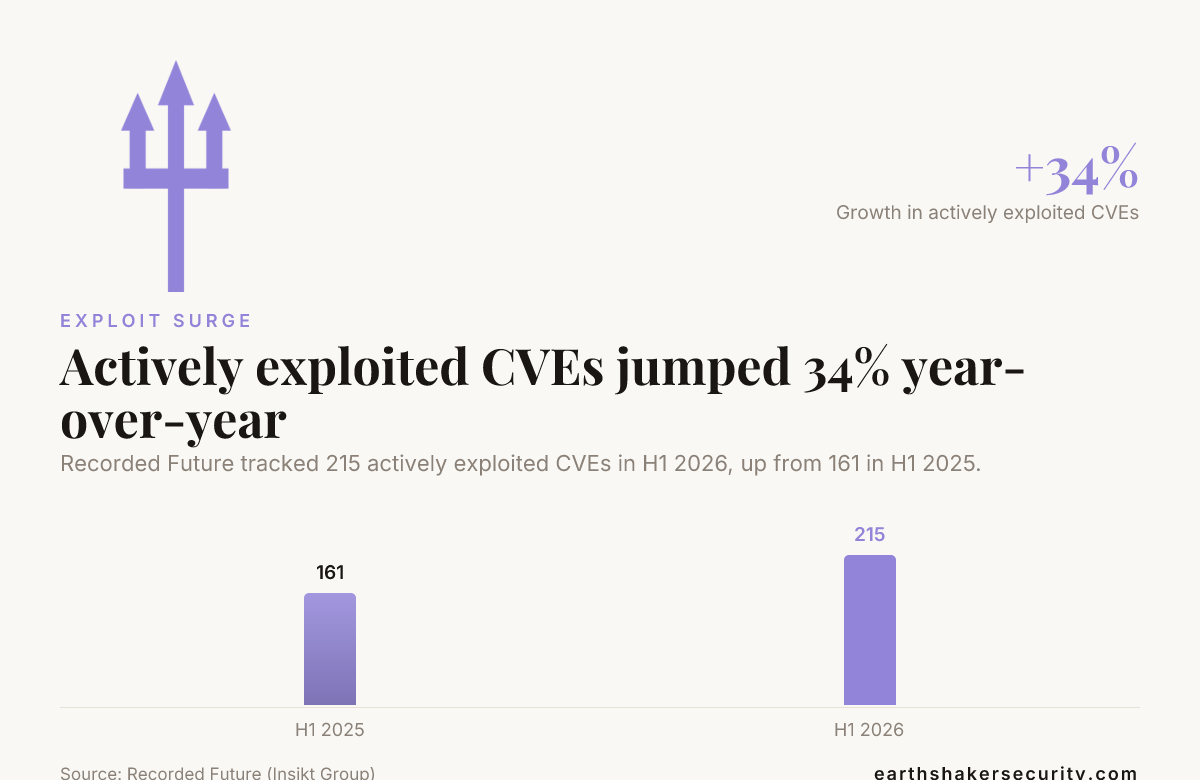
Recorded Future tracked 215 actively exploited CVEs in H1 2026, up from 161 in H1 2025.
Exploit trend relevance shows up in three ways for database risk:
- Unauthenticated entry: when vulnerabilities can be exploited without prior authentication and are network-accessible, attackers can reach application and API paths that lead to database queries.
- Remote code execution paths: remote code execution with network access and no authentication can accelerate movement towards systems that include database credentials or database services.
- Stolen accounts: account compromise often turns into horizontal privilege escalation, where the attacker uses legitimate access to browse other users' records.
This is why we do not treat privilege escalation vulnerability reviews as isolated endpoint checks. We treat them as pathways from entry to database actions.
Did you know? Privilege escalation is one of the most exploited stages in the cyberattack lifecycle.
Source: Huntress
How we test for horizontal and vertical privilege escalation in authorisation logic
When we run web app and API assessments, we focus on the areas where privilege escalation vulnerability classes are most likely to become database relevant. Our approach covers recon and enumeration, then proof-only exploitation, then reporting and re-testing.
In developer terms, the two most useful inputs are usually route coverage and role mapping. If you test only one role, or only the “happy path”, you can miss the vertical privilege escalation in cyber security attack paths that appear in downgraded sessions, deleted sessions, or alternative workflow states.
Our scope and reporting also matter. We document reproduction steps and evidence, and we provide a specific fix, so the fix can be validated during re-test. That model supports practical remediation rather than theory.
If you want a quick sense of how this becomes a finding format, review our sample report page, which includes an example finding with impact, the fix, and evidence structure (see sample pentest report).
Common pitfalls in LPE vulnerability reviews that affect database access
Local privilege escalation (LPE) is different from application-level privilege escalation, but it matters because organisations often treat “system compromise” as separate from “data compromise.” In reality, database impact can follow both.
In web app testing and privilege escalation reviews, LPE often shows up indirectly, through misconfiguration, unsafe service permissions, or overly permissive execution contexts that allow a foothold to become higher control over the host running database components.
Common pitfalls that cause privilege escalation vulnerabilities to slip include these:
- Confusing authentication with authorisation: the app may authenticate correctly but fail to authorise actions per role and per object.
- Missing enforcement at the data access layer: application services pass object ids around, and ownership is assumed rather than asserted.
- Under-testing of API and endpoint behaviour: endpoint authorisation differs from UI behaviour, and the UI can mask broken logic.
- Not testing session state changes: downgraded sessions, deleted sessions, or role transition flows can create vertical privilege escalation vulnerabilities.
One practical example we see in investigations is what happens when authorisation exists only in the UI, while the endpoint behind it still performs the database query without ownership checks. That is a direct bridge from broken object access to database disclosure, which is why horizontal often wins for data exposure speed.
Practical testing choices if you want the answer for your database
If your goal is to decide “Vertical vs horizontal privilege escalation: which threatens your database more?” for your system, treat it like a test planning problem with evidence output.
We would usually start with a small scope that targets the highest privilege boundaries and the highest record density paths. In our pricing, the Starter option targets a single app or site tested unauthenticated, and Pro expands to authenticated testing across roles and API or endpoint testing, depending on what you run (see pricing).
When you look at your own risk, use this checklist:
- List all database-backed resources that are accessed via object identifiers, then test for object ownership enforcement.
- List all roles and role transitions that reach privileged workflows, then verify backend authorisation for each request.
- Check for chained routes, where one bug provides access that triggers the next authorisation failure and increases database reach.
- Validate fixes by re-testing, because privilege escalation vulnerabilities can be easy to partially fix while leaving a gap in another route or state.
If you want a structured method for how this turns into a repeatable engagement, we use a consistent recon, enumerate, prove, report, and re-test flow (see our methodology).
Frequently asked questions about privilege escalation and database risk
Is vertical privilege escalation more dangerous than horizontal privilege escalation for databases in 2026?
Vertical can be more dangerous when it grants higher privilege that enables broad reads and writes. Horizontal is often more dangerous for direct data exposure because a single broken object ownership check can expose other records with the same role, which is why “Vertical vs horizontal privilege escalation: which threatens your database more?” depends on how your authorisation model is built.
What is the most common privilege escalation vulnerability in web applications?
In application testing, broken object level access control is a frequent issue, often discussed as IDOR. That horizontal privilege escalation vulnerability class directly maps to database disclosure when the backend fails to enforce ownership during data-layer queries.
How do web apps fail vertical vs horizontal privilege escalation checks?
Vertical failures usually occur when backend checks do not enforce authorisation based on role or privilege state. Horizontal failures usually occur when object identifiers are accepted without verifying ownership, so the attacker can access other users' objects even with the same privilege level.
How do you test for privilege escalation vulnerability without causing damage?
A practical approach is proof-only exploitation, where you reproduce the failure and demonstrate impact without exfiltrating data or performing harmful actions. You then capture clear evidence and re-test after remediation so you can confirm that the fix closes the privilege boundary.
Does stealing accounts cause horizontal privilege escalation?
Stolen account access aligns strongly with horizontal privilege escalation because the attacker has legitimate session capability but can browse or request other users' objects if ownership checks fail. This is why account takeover often becomes a direct database exposure path when object-level authorisation is weak.
Is LPE vulnerability testing relevant to database compromise?
Yes, because host compromise can lead to database credential exposure, database service access, or manipulation of the environment around database components. In practice, database compromise can follow multiple routes, including application privilege escalation and local privilege escalation paths.
Conclusion: answering Vertical vs horizontal privilege escalation: which threatens your database more?
Vertical vs horizontal privilege escalation: which threatens your database more? The answer depends on what fails in your authorisation model. Horizontal privilege escalation more directly exposes records when object ownership checks fail, while vertical privilege escalation can widen control through role or privilege state failures, potentially expanding database access into broader actions.
In 2026, the operational reality is that privilege escalation vulnerability classes are common enough and exploit pathways are reachable enough that both types deserve the same level of testing discipline. We approach this as pathways to database actions, with evidence-driven findings, fixes mapped to the specific boundary failure, and re-testing to confirm closure (see services).
To evaluate your database exposure from privilege escalation attack paths, review a scoped assessment that covers both object-level and role-level authorisation issues.