Security Teams: Vulnerability Prioritization by Exploit Risk, Not CVSS
Prioritize vulnerabilities by exploit evidence plus asset criticality plus exposure, not by CVSS score alone. That's the single rule: a CVE with a confirmed exploit (CISA KEV) or high exploitation probability (EPSS) sitting on an internet-facing, high-criticality asset jumps the queue regardless of its base score. Starting today, check KEV and EPSS daily, map every finding to asset criticality and exposure, and auto-route KEV hits straight into tickets with an SLA clock attached.
TL;DR:
- Rely on exploit evidence and asset exposure, such as CISA KEV and EPSS, to prioritize vulnerabilities over CVSS scores alone.
- Use a decision tree approach for escalation rules, focusing on KEV status first, then on EPSS and asset exposure, for real-time prioritization.
- Validate scanner findings consistently and maintain accurate, up-to-date asset inventories to ensure reliable risk assessment updates.
- Incorporate complex modeling like graph-based asset analysis and runtime validation to identify compounded and active exploit paths.
- Focus on proactive daily checks of KEV and EPSS, regular triage meetings, and rapid remediation for the highest-risk, actively exploited vulnerabilities.
Table of Contents
What Is Vulnerability Prioritization?
Vulnerability prioritization is the process of ranking security findings by the real-world risk they pose to a specific business, rather than by a generic severity number. This is the operational core of risk-based vulnerability management: instead of patching in the order a scanner lists findings, you patch in the order that actually reduces breach risk. The distinction matters because most organizations don't have the staff to fix everything a scanner flags in any given month, so the ranking itself becomes the security decision.
The industry has a formal name for the discipline behind this: risk-based vulnerability management (RBVM). It pulls in exploit evidence, asset context, and business impact instead of relying on a single lab-derived score. A systematic literature review of vulnerability prioritization metrics that examined 82 studies found the field breaks down into five categories: severity, exploitability, contextual factors, predictive indicators, and aggregated system-level metrics. Most teams over-rely on the first category and ignore the other four. That imbalance is exactly what this guide corrects.
Why CVSS Alone Is Not Enough
CVSS gives you a starting point, not a verdict. The Common Vulnerability Scoring System combines base metrics (attack vector, complexity, privileges required), temporal metrics (exploit maturity, patch availability), and environmental metrics (your specific configuration) into a 0 to 10 score maintained through the National Vulnerability Database. The problem is what CVSS doesn't measure: it says nothing about whether anyone is actually exploiting the vulnerability in the wild.
That gap produces a strange result. Plenty of CVEs sit at 9.0 or higher and are never observed being exploited, while some CVEs scored in the 5 to 6 range end up in active ransomware campaigns because they're trivially reachable and widely deployed. Using CVSS as your only filter means you'll burn engineering hours patching theoretical risk while a lower-scored, actively exploited bug sits untouched.
A workable model weights CVSS as one input among several:
- CVSS score: baseline severity, roughly 20 to 25% of the decision weight
- EPSS probability: likelihood of near-term exploitation, similarly weighted
- CISA KEV status: binary override, if present, escalate regardless of other scores
- Asset criticality and exposure: the multiplier that decides urgency once severity and exploitability are known
Statistic callout: Security teams that lean on CVSS in isolation routinely discover that a large share of their "critical" backlog has no observed exploitation at all, a pattern well documented across the exploitability research that underlies EPSS. Severity and exploitation are correlated, but they are not the same measurement.
The Signals That Actually Drive a Prioritization Decision
Four inputs do most of the work once you move past CVSS: EPSS, CISA KEV, asset criticality, and exposure. Each answers a different question, and skipping any one of them leaves a blind spot.
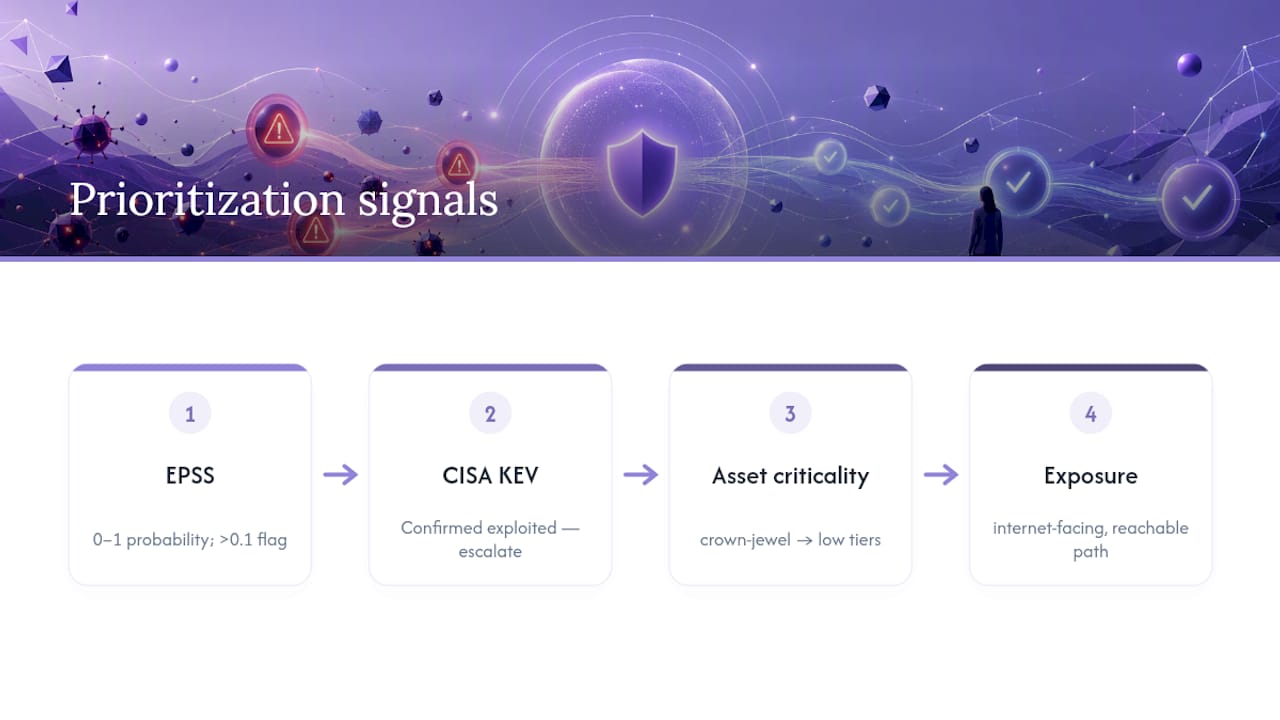
EPSS estimates the probability that a given CVE will be exploited in the next 30 days, scored from 0 to 1. Most teams set an escalation threshold around 0.1 (a 10% chance), treating anything above that as a candidate for expedited remediation, and anything above 0.5 as near-certain to warrant immediate action per FIRST's EPSS model.
CISA KEV is the higher-confidence signal. It doesn't predict exploitation, it confirms it. Anything on the Known Exploited Vulnerabilities catalog should be treated as a move-to-front ticket for any affected internet-facing or high-criticality asset, checked daily rather than weekly.
Asset criticality sorts your environment into tiers: crown-jewel systems holding regulated or sensitive data, business-critical services with defined uptime requirements, and everything else. A vulnerability on a payment processing box is not the same finding as the identical CVE on an internal wiki, even though the CVSS score is identical.
Exposure and reachability close the loop: is the asset internet-facing, does it sit behind a jump host, and does the vulnerable code path actually execute in production. A three-step approach from TechTarget folds severity, data sensitivity, and existing compensating controls into a single composite rating, which is a practical way to operationalize this without building a research project.
Pro Tip: Build your escalation rule as a decision tree, not a spreadsheet formula. "If KEV, escalate. Else if EPSS > 0.1 and asset is internet-facing, escalate. Else score normally." It's easier for an on-call engineer to apply at 2 a.m. than a weighted average.
The Failures That Quietly Break Prioritization Programs
Most prioritization programs don't fail because the model is wrong. They fail because the inputs feeding the model are broken, and nobody notices until the queue stops being trusted.
- Unvalidated scanner output. Scanners produce false positives at meaningful rates, and every unvalidated finding that lands in an engineer's queue and turns out to be noise erodes trust in the next real finding. Validate at scale with runtime checks or spot manual verification before a finding reaches a ticket.
- Stale or incomplete asset inventories. You can't rank exposure on assets you don't know exist. Continuous discovery, not quarterly spreadsheets, is the only way to keep criticality tags accurate as cloud environments and containers churn.
- Broken handoffs between security and IT ops. A finding without a named owner, a defined exception process, or an agreed SLA sits in limbo. RBVM guidance from Tanium points to exactly this trio, incomplete inventory, unvalidated findings, and handoff friction, as the recurring operational gap behind stalled remediation.
- Over-reliance on a static score computed once. EPSS moves week to week as exploitation activity shifts. A score computed at scan time and never revisited is already stale by the next triage meeting.
Fixing these four issues usually does more for your remediation speed than any change to the scoring formula itself.
A Repeatable Vulnerability Remediation Workflow
A defensible vulnerability remediation plan runs through seven stages, and most of them can be automated except the final human checkpoint.
- Discover. Continuously enumerate workloads, containers, managed services, and identities, not just servers. Anything unscanned is a blind spot by definition.
- Enrich. Pull CVSS from NVD, exploitation probability from EPSS, confirmed exploitation from CISA KEV, and overlay asset tags and threat intelligence feeds tracking active campaigns relevant to your stack.
- Score. Combine the inputs into a composite rating. A workable starting formula: severity (25%), exploit probability (25%), KEV override (automatic escalation if present), asset criticality (25%), and exposure/reachability (25%). Adjust weights as your environment's risk profile demands.
- Validate. Confirm the finding is real before it reaches a ticket. Runtime checks, breach and attack simulation (BAS) signals, or targeted manual verification convert a noisy scanner list into a trusted remediation queue.
- Remediate. Route to a named owner with evidence attached (the specific finding, the affected asset, the reachability confirmation) and a risk-tier SLA clock running.
- Verify. Re-test after the fix ships. A closed ticket without verification is an assumption, not a resolution.
- Measure. Track outcomes over time, not just activity.
Metrics worth tracking monthly:
- Mean time to remediate (MTTR), broken out by risk tier, not blended into one average
- Exploitable exposure count: the number of KEV or high-EPSS CVEs currently unresolved on internet-facing assets
- Backlog aging: how many findings have sat past their SLA window
- Reduction rate: month-over-month change in exploitable exposure, which is the number that actually tells you whether the program is working
Business context belongs in the enrichment stage too. Mapping which systems support revenue-critical or continuity-sensitive functions, the kind of assessment covered by resources like KnowSpan's continuity risk framework, sharpens the asset criticality tier beyond a simple "production vs. staging" label.
Advanced Methods That Sharpen the Signal
Static scoring, even a well-weighted composite, still treats vulnerabilities as isolated events. The more sophisticated approaches look at how findings compound.
Graph-based environment modeling maps assets, identities, and network paths together, and it's how security teams spot "toxic combinations": a moderate vulnerability sitting on a workload with admin-equivalent identity permissions and direct internet exposure. Individually, none of those three factors triggers an alarm. Together, graph models surface them as the highest-priority item in the environment, something a flat CVSS list will never catch.

Runtime validation answers a narrower but critical question: is the vulnerable code actually loaded and executing, or does it sit in a library that's present but never called? Confirming service reachability at runtime turns "theoretically vulnerable" into "actually exploitable," which is the difference that should drive your ticket queue.
Predictive and machine learning models can flag CVEs likely to be weaponized before KEV confirmation catches up, but they carry real trade-offs. They need high-quality, near-real-time telemetry to stay accurate, and opaque model outputs are hard to defend in an audit or a board conversation. The literature review on prioritization metrics recommends pairing predictive models with explainable features and clear confidence thresholds rather than treating model output as gospel.
- Automate: KEV ingestion, EPSS threshold escalation, ticket creation, and re-test scheduling
- Require human review: any finding that triggers automated remediation on a production-critical asset, and any model-flagged prediction below your confidence threshold
Pro Tip: Treat "confidence threshold" as a governance decision, not just a technical one. Get security leadership sign-off on what confidence level triggers auto-remediation versus mandatory human review before you deploy a predictive model, not after an automated fix breaks something in production.
A Daily Playbook for Triage and Remediation
A prioritization program only works if it runs on a rhythm. Here's a lean daily and weekly structure that scales from a five-person security team to a much larger one.
Daily runbook:
- Cross-check new CISA KEV entries against your asset inventory; auto-open tickets for matches on high-criticality or internet-facing systems
- Re-validate the top 50 items in the active queue against current EPSS scores, since probability shifts week to week
- Confirm every new ticket carries evidence: affected asset, exploitability signal, reachability confirmation
Triage meeting checklist (weekly):
- Required evidence per item: CVSS, EPSS trend, KEV status, asset tier, exposure confirmation
- Decision outcome per item: Act (remediate now), Attend (schedule within SLA), or Track (accept risk with documented owner and review date)
- Named owner assigned before the meeting ends, not after
Sample SLA windows by tier: a KEV-listed CVE on an internet-facing, high-criticality asset gets 24 to 48 hours. A high-EPSS, non-KEV finding on a critical asset gets 7 days. Everything else follows a 30 to 90 day cadence based on criticality tier.
Statistic callout: Analysis of actively exploited CVEs shows a large share pre-date 2021, meaning attackers are frequently walking through old, unpatched doors rather than racing to weaponize the newest disclosure. A daily KEV check catches these stale, high-value targets that a "patch the newest CVEs first" policy would miss entirely.
How Earthshaker Security Supports Prioritized Remediation
Some security testing providers combine automated scanning with manual verification to reduce false positives that undermine trust in a prioritization queue. Every finding is hand-verified before it reaches a client report, so the tickets your team receives are already validated, not raw scanner output that still needs triage.
That verification step matters for remediation speed. A hand-checked finding comes with evidence and a concrete fix, which means an engineer can act on it immediately instead of spending an hour confirming the finding is real before deciding whether to act on it at all.
Typical engagement types that support exposure and asset-context prioritization work include:
- Authenticated web application penetration testing to surface access control and logic flaws that scanners may miss
- API and endpoint testing to cover the exposure surface often underrepresented in inventories
- External attack surface reviews to map what is actually internet-reachable
- Configuration and hardening audits to identify gaps between "patched" and "properly configured"
Readers who want to see what verified evidence looks like in practice can review the testing methodology or an actual sample report before engaging.
Case Studies: What Prioritization Looks Like in Practice
A mid-sized SaaS company running a standard vulnerability scanner once had over 400 "critical" findings sitting in its backlog, ranked purely by CVSS. Once the team overlaid EPSS and CISA KEV, only 11 of those 400 carried either confirmed exploitation or meaningful exploit probability. The security team redirected its patch cycle toward those 11, closing the highest-risk exposure in under two weeks instead of spending a quarter grinding through the full list in CVSS order.
A different pattern shows up in retail and e-commerce environments, where a moderate-severity CVE on a payment gateway component often outranks a "critical" finding on an internal analytics dashboard once asset criticality and data sensitivity are factored in. The CVSS scores alone would rank them in reverse order.
The graph-based "toxic combination" scenario plays out constantly in cloud environments: a container image with an outdated library, an over-permissioned service identity, and a public load balancer in front of it. None of the three factors alone triggers urgent action. Together, they represent a direct path from internet exposure to lateral movement across the environment, which is exactly the kind of compounding risk a flat severity list can't represent.
Across all three patterns, the lesson repeats: the ranking that matters isn't the one with the highest score, it's the one with the shortest, most reachable path from "vulnerable" to "breached."
Editorial Take: What the Data Actually Supports
The conventional advice, patch everything scored 9.0 and above first, isn't just inefficient. It's actively misleading, because it treats a lab-derived severity number as a proxy for real-world risk when the two are only loosely correlated. The teams getting this right have stopped asking "how bad could this be" and started asking "is this actively being exploited, and can an attacker reach it." That's a smaller, harder question, and it's the one that actually predicts breaches.
Where I think most programs still get it backwards: they treat validation as a nice-to-have step for mature teams, when it should be the first investment any team makes. An unvalidated finding in a ticket queue costs you credibility with engineering every single time it turns out to be noise, and that credibility doesn't come back cheap. Prioritization built on untrusted data is worse than no prioritization at all, because it creates false confidence.
Start with KEV and EPSS daily checks. Add asset criticality mapping next. Validation and graph modeling come after you've proven the basics work.
— caleb
Sources
FAQ
What Are the Five Steps of Vulnerability Management?
The typical cycle runs discover, prioritize, remediate, verify, and measure, sometimes shown as identify, evaluate, treat, track, and report, but the core sequence is the same regardless of naming.
What Is the Difference Between CVSS and EPSS Scores?
CVSS measures theoretical severity on a 0 to 10 scale based on how a vulnerability could be exploited, while EPSS estimates the actual probability, 0 to 1, that a specific CVE will be exploited in the near term. CVSS answers "how bad," EPSS answers "how likely."
What Are the Four Types of Vulnerability?
Security frameworks generally group vulnerabilities into technical (software flaws), configuration (misconfigured systems), human (phishing susceptibility, weak credentials), and process (missing patch management or access review procedures).
What Are the Four Stages of Vulnerability Assessment?
Most frameworks describe scanning, analysis, prioritization, and remediation as the four core stages, sometimes with a fifth reporting stage added for compliance-driven programs.
How Often Should Teams Check CISA KEV and EPSS?
Check the CISA KEV catalog daily since new confirmed exploits can appear at any time, and re-check EPSS scores at least weekly since probability estimates shift as exploitation activity in the wild changes.
Recommended