Field note
Methodology First OWASP Web Application Penetration Testing for Teams
Methodology first, OWASP-aligned guide for security teams. Follow a stepwise testing process, gather proof of concept evidence, and deliver...
Methodology first, OWASP-aligned guide for security teams. Follow a stepwise testing process, gather proof of concept evidence, and deliver...
Web application penetration testing is a controlled, authorized attempt to find and exploit security flaws in a live application before someone with worse intentions does. If you're starting one today, your first move isn't scanning. It's locking down scope, getting test accounts for every user role, and standing up a proxy like Burp Suite or OWASP PTK. Frameworks like the OWASP WSTG and PTES define the process; a firm like Earthshaker Security can run it for you if you'd rather not.
TL;DR:
- Proper scope definition and test account setup are crucial to avoid wasting resources and ensure accurate findings during penetration testing.
- Combining manual verification with automated tools reduces false positives and uncovers business logic flaws that scanners cannot detect.
- Focus testing on high-impact OWASP categories like injection, access control, and authentication to identify most severe vulnerabilities efficiently.
- Using grey-box testing with limited credentials provides a realistic attack scenario, making it the preferred approach for most engagements.
- A comprehensive report with prioritized findings and specific remediation steps significantly increases the chances of prompt fixing and mitigation.
People confuse a penetration test with a vulnerability assessment constantly, and the mix-up wastes budgets. A vulnerability assessment scans for known weaknesses and hands you a list. A web application penetration test goes further: a tester actively exploits what they find, chains flaws together, and proves what an attacker could actually reach. The goal isn't a catalog of theoretical issues. It's evidence of exploitability, measured business impact, and validation that your existing controls hold up under pressure.
A properly scoped engagement produces deliverables you can act on, not a wall of red and yellow rows:
Skip any of these and you've paid for a scan with better branding.
Most organizations don't schedule a test because someone woke up feeling proactive. There's usually a trigger: a pre-launch deadline, a compliance auditor asking for evidence, a breach that just happened somewhere in the supply chain, an acquisition where nobody trusts the target company's code, or a customer contract that demands third-party validation.
The trigger should decide your testing depth:
Match the approach to the goal. Compliance auditors often want documented coverage; a security team bracing for a targeted attack wants exploitability proof.
Frameworks differ in vocabulary, but the BSI's penetration testing model and PTES converge on the same skeleton. Here's the workflow that holds up across engagements of any size.
Pro Tip: Run infrastructure reconnaissance before application testing whenever scope allows it. Compromising a misconfigured service can change your entire assessment, and the BSI study treats combining infrastructure and application testing as standard practice, not an optional extra.
The OWASP Web Security Testing Guide breaks active testing into over a dozen categories, and treating it as a checklist to validate rather than a box to tick is the whole point of the guide. Build your test plan around these buckets:
Most critical findings cluster in a predictable place. Injection flaws, broken access control, and weak authentication account for the bulk of high-severity results across practitioner assessments, which is exactly why authorization and input validation deserve more tester hours than a quick automated pass.
Set up an intercepting proxy first. Burp Suite is the industry standard, and OWASP PTK is a strong open-source alternative that captures authenticated browser state directly, which matters if you're testing a single-page application where half the interesting traffic never touches a traditional page load.
Layer automation on top of that foundation rather than relying on it alone:
Automated scanners are good at breadth and bad at judgment. They'll flag a hundred things, and maybe five matter. Manual verification is what separates a real finding from noise, and it's the only way to catch business logic flaws a scanner has no concept of. If you're testing an externally facing target from a distributed set of source IPs to avoid rate-limit skew during reconnaissance, a provider like NatProxies can supply the ISP proxy infrastructure for that.
Capture evidence as you go: full request and response logs, screenshots of successful exploitation, and a reproducible PoC for every finding you plan to report. Watch your request rate against production systems. A test that trips a client's incident response team at 2 a.m. is a bad look, even when it's technically in scope.
Proving impact doesn't require breaking things. Non-destructive proof-of-concept techniques, like reading a single non-sensitive record to demonstrate an IDOR or triggering a benign out-of-band callback to confirm SSRF, establish exploitability without creating cleanup work for the client.
A report structure that gets findings fixed follows a consistent anatomy: executive summary, technical reproduction steps, a risk rating tied to business consequence, remediation guidance, and clear retest criteria. Reports built this way see measurably higher remediation follow-through than a raw finding dump, according to OWASP's own reporting guidance. If you want to see what that looks like in practice, Earthshaker Security publishes a sample report showing the format.
Pro Tip: Never demonstrate destructive impact (dropping a table, deleting production data) to prove a point. Show the door is unlocked without walking through it and rearranging the furniture.
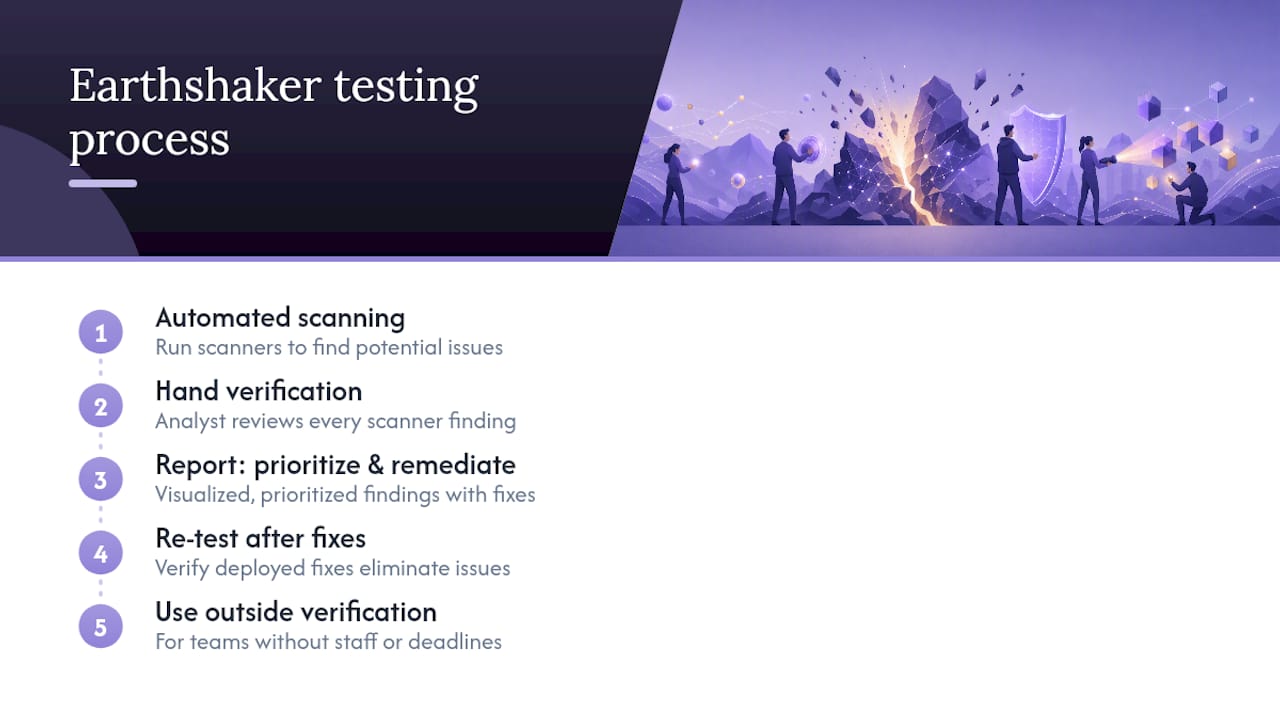
A professional penetration testing service pairs automated scanning with hand verification on every finding to cut false positives that can make raw scanner output nearly useless to a dev team. Reports typically include visualized, prioritized findings with concrete remediation steps, plus a re-test once fixes ship. Full details on the approach sit on the methodology page. Internal teams without dedicated security staff, or ones facing a compliance deadline, tend to benefit most from bringing in outside verification rather than relying solely on in-house scanning.
The recurring failure isn't technical. It's a scope document that says "test the web app" with no account list, no maintenance window, and no named contact for when something breaks. Add uncoordinated scanning against production and you've got an engagement heading for a bad debrief.
Before you commission a test, have four things ready: a written scope document, credentials for every user role, a defined test window with an on-call contact, and clear acceptance criteria for what a successful retest looks like.
— caleb
Running this methodology in-house takes real tester hours and a proxy setup most dev teams never build twice. Earthshaker Security exists for the gap between "we should test this" and "we actually did," combining automation with hand-verified findings so you're not stuck deciphering raw scanner output at 11 p.m. before a launch.
Engagements run three ways. Starter is a one-off test at $1,000, suited to a single application before launch. Pro covers deeper scope with pricing available on request. The Retainer plan, at $795 per month, fits teams shipping frequently who need ongoing coverage rather than a single snapshot. Larger or nonstandard scopes run as a Custom engagement priced on a daily rate basis. Every tier includes hand-verified findings, remediation guidance written for developers, and a re-test once fixes are in. Check the full service catalog to see which tier matches your application, or review pricing directly to get a quote started.
It's an authorized, simulated attack on a live web application designed to find and exploit real vulnerabilities rather than just list theoretical ones. Earthshaker Security runs these as hand-verified engagements, detailed on its services page.
Most methodologies converge on scoping, reconnaissance, mapping and discovery, exploitation, and reporting, sometimes splitting discovery and exploitation into separate steps for six total phases. The BSI model frames these as a structured, repeatable sequence rather than a loose set of tasks.
Burp Suite is the most widely used intercepting proxy for this work, with OWASP PTK as a strong open-source option for authenticated and single-page application testing. Nmap, Gobuster, and sqlmap round out the common automated toolchain for reconnaissance and injection testing.
A condensed version of the methodology collapses to planning, discovery, attack, and reporting, folding scoping into planning and mapping into discovery. It's the same underlying process as the five or six-phase model, just grouped differently.
The Starter engagement runs $1,000 one-off, and the Retainer plan is $795 per month for ongoing coverage. Pro and Custom engagement pricing depend on scope, so check current pricing directly.