3 Stage Multi Tenant Security Roadmap for Engineers: RLS Verification
Practitioner cheat sheet for engineers: apply OWASP and NIST zero trust, verify RLS with database first tests, and follow a 3 stage roadmap.
Secure multi-tenant systems enforce server-verified tenant context and layered identity-first isolation across application, data, cache, and infrastructure layers, backed by continuous testing. No single control stops cross-tenant breaches: you need tenant binding at every request, enforceable data boundaries, and routine verification including human-led penetration testing to catch the authorization bugs automated scanners miss.
TL;DR:
- Tenant context must be bound to verified identity claims and propagated consistently across all services to prevent impersonation and data leakage.
- Using separate databases or schemas significantly reduces risk, but row-level security requires strict policies and thorough testing to avoid silent bypasses.
- Continuous verification of internal and external service identities, along with strict resource quotas and tenant-aware API controls, is essential to enforce zero trust.
- Shared infrastructure like caches, storage, and networks must include tenant identifiers in keys and implement strict access checks to prevent cross-tenant leaks.
- Regular, manual security testing and comprehensive logging are critical to identify and respond quickly to authorization gaps and tenant-specific breaches.
Table of Contents
- Key risks in multi-tenant environments
- Tenant identification and request context management
- Data-layer isolation strategies: databases, schemas, and RLS
- Authentication, authorization, and zero trust for multi-tenant apps
- API gateway, service mesh, and service-identity controls
- Cache, session, and blob storage isolation
- Resource isolation and noisy-neighbor protection
- Tenant lifecycle: onboarding, offboarding, and governance
- Logging, monitoring, and tenant-scoped audit trails
- Database-specific testing and RLS verification
- Concrete implementation checklist and prioritized mitigations
- Securing third-party integrations and plugins
- Incident response planning for multi-tenant environments
- Compliance considerations for multi-tenant security
- Encryption strategies for multi-tenant data
- Network segmentation and micro-segmentation techniques
- When to bring in a security testing partner
- How we help secure multi-tenant applications
- FAQ
- Sources
Key risks in multi-tenant environments
Multi-tenant architectures concentrate many customers' data behind shared infrastructure, which means a single authorization gap can expose every tenant at once. The OWASP multi-tenant security cheat sheet catalogs the recurring failure modes that cause the most damage in production systems.
- Cross-tenant data leakage: queries or cached responses return rows belonging to another tenant, often through a missing WHERE clause or a stale cache key.
- IDORs and tenant impersonation: an attacker swaps an identifier in a request and the backend serves the resource without checking tenant ownership.
- Privilege escalation through shared admin paths: an account with elevated rights in one tenant context reaches administrative functions meant for another.
- Noisy-neighbor resource exhaustion: one tenant's workload consumes shared database connections, CPU, or queue capacity and degrades service for everyone else.
- Shadow and ephemeral tenant sprawl: test tenants, demo environments, or abandoned trial accounts persist with weaker controls and become pivot points for attackers.
Tenant impersonation and IDOR-style access bypass rank among the most common multi-tenant vulnerabilities documented by OWASP, alongside noisy-neighbor and cache-leakage patterns, according to the OWASP cheat sheet. Each of these risks maps to a specific control category: identity verification, data boundary enforcement, resource quotas, and lifecycle governance, which the following sections cover in turn.
Tenant identification and request context management
The foundation of multi-tenant security is establishing who the caller is and which tenant they belong to before any business logic runs, and never trusting a client-supplied tenant identifier to make that determination.
- Bind tenant context to the authenticated principal, deriving it from a verified token claim or session record rather than a request parameter.
- Establish tenant context in middleware or an interceptor as early as possible in the request pipeline, before any data access code executes.
- Propagate that context consistently to downstream services, background jobs, and telemetry so every log line and service call carries the same tenant identifier.
- Reject any request where the tenant context cannot be resolved from a trusted source, rather than defaulting to a permissive value.
Opaque, non-sequential tenant and resource IDs reduce the risk of enumeration attacks, but they are not a substitute for authorization checks: an attacker who guesses or leaks a valid opaque ID still needs to be blocked by a server-side ownership check, not by the obscurity of the identifier itself.
Pro Tip: Log the resolved tenant ID alongside the authenticated user ID on every request so a mismatch between the two becomes an instantly searchable signal during an investigation.
Data-layer isolation strategies: databases, schemas, and RLS
Choosing a data isolation model is a trade-off between security strength, infrastructure cost, and migration complexity, and the right answer depends on how sensitive the tenant data is and how many tenants you expect to run.
- Separate databases per tenant give the strongest isolation and the simplest blast-radius story, but multiply backup, patching, and migration overhead as tenant count grows.
- Separate schemas within a shared database reduce operational overhead while keeping a reasonable boundary, provided connection roles are scoped per schema.
- Shared tables with row-level security (RLS) scale efficiently for high tenant counts but concentrate risk in policy correctness and require strict testing discipline.
PostgreSQL's own documentation is explicit about where RLS can quietly fail.
Table owners, superusers, and roles with the BYPASSRLS attribute bypass row security policies by default. Enabling FORCE ROW LEVEL SECURITY makes the policies apply even to the table owner.
That caveat matters operationally: migration scripts, backup jobs, and admin tooling often connect with privileged roles, and if those roles share a connection path with application code, a policy that looks correct in review can be silently ignored in production. Map each data classification tier, such as regulated personal data versus internal configuration, to the strongest isolation boundary it justifies, and document which tables rely on RLS versus schema or database separation.
Authentication, authorization, and zero trust for multi-tenant apps
NIST SP 800-207A recommends shifting enforcement away from network location and toward identity, using identity-tier policies and service identity infrastructures such as SPIFFE to authorize calls between services in multi-cloud and multi-cluster deployments. For multi-tenant applications, that principle translates into a few concrete practices.
- Treat every service-to-service call as untrusted by default and require continuous verification of identity and scope, not a one-time login.
- Issue strong service identities for internal calls, validating tokens cryptographically rather than relying on network segmentation alone.
- Enforce tenant scope at every authorization boundary, including internal APIs and background workers, not just the public-facing endpoint.
- Apply conditional access and multi-factor authentication to any role with cross-tenant administrative privileges.
Least privilege is the throughline: a support engineer's tooling should only reach the tenants assigned to an active case, and that scope should be enforced by the authorization layer rather than by convention or UI restriction.
API gateway, service mesh, and service-identity controls
Runtime enforcement points give you a place to apply tenant rules consistently, independent of whatever a given service's internal code does correctly or incorrectly. NIST's zero trust guidance describes combining network-tier and identity-tier policies using sidecar proxies, ingress and egress gateways, and service mesh artifacts, which NIST SP 800-207A frames as a way to keep policy enforcement consistent across multi-cloud, multi-cluster deployments.
- Use ingress and egress gateways to limit which services can initiate cross-tenant-adjacent calls in the first place.
- Deploy sidecar proxies or a service mesh to check caller identity and authorization on every internal call, not just at the perimeter.
- Apply tenant-aware rate limiting and quotas across every shared bottleneck, including database connection pools and message queues, not only HTTP request counts.
- Scope API credentials to specific tenant sets so a leaked key cannot reach the entire customer base.
These controls catch what application code sometimes misses, since a gateway or mesh policy applies uniformly even when a new service is added without full security review.
Cache, session, and blob storage isolation
Shared infrastructure layers outside the primary database are common sources of silent cross-tenant leaks. Classify every cached value as global, tenant-scoped, or user-scoped, and include the tenant identifier directly in the cache key whenever the value is not global, a pattern the OWASP cheat sheet recommends alongside separate cache instances for higher-risk tenants.
- Never treat a cache-returned value as pre-authorized: run the same ownership check you would run against the primary data source.
- For object or blob storage, isolate at the container or bucket level and consider per-tenant encryption keys and distinct access credentials for sensitive tenants.
- Bind session tokens to tenant context so a hijacked or replayed session cannot be reused across tenant boundaries, and set cookies with strict same-site and secure attributes.
Resource isolation and noisy-neighbor protection
One tenant's traffic spike should never degrade service for another tenant, which requires quotas that go beyond simple HTTP rate limits.
- Set per-tenant quotas on database connections, CPU allocation, memory, and queue throughput, not just API request counts.
- Route heavy or unpredictable workloads to dedicated worker pools or scheduling tiers, keeping shared pools reserved for typical usage.
- Tie alerting and auto-throttling to tenant SLAs so a quota breach triggers action before it cascades into a wider outage.
Tenant lifecycle: onboarding, offboarding, and governance
Microsoft's Secure Future Initiative frames tenant discovery as the first step in securing tenants and their resources, since governance and baselines cannot apply to a tenant nobody knows exists.
- Automate provisioning against a baseline security template, including default quotas and permission sets, so no tenant launches with manually configured, inconsistent controls.
- Treat ephemeral or trial tenants with the same baseline rather than a relaxed one, since they are frequently the least monitored and most exploited.
- On offboarding, revoke API keys, rotate any shared secrets, sanitize or purge backups per your retention policy, and confirm data deletion where contractually required.
- Maintain a central tenant inventory and run periodic lifecycle audits to find abandoned or shadow tenants before an attacker does.
Pro Tip: Schedule a recurring inventory reconciliation between your billing system and your tenant database: a mismatch usually means a forgotten test or trial tenant still has live access.
Logging, monitoring, and tenant-scoped audit trails
Every request should carry its resolved tenant identifier into logs, and that trail needs to stay immutable to hold up during an audit or incident review.
- Log tenant context on every request, every background job, and every administrative action, not only on data-modifying operations.
- Centralize telemetry across services so a cross-tenant anomaly is visible in one place instead of scattered across isolated logs.
- Build detection rules specifically for tenant impersonation attempts, mass enumeration of tenant or resource IDs, and unexpected privilege elevation.
- Set retention periods that satisfy both operational investigation needs and any regulatory evidence requirements for your sector.
Microsoft's tenant security guidance recommends posture metrics and tenant-specific alerting as part of lifecycle governance, treating telemetry as a governance tool rather than an afterthought, according to Microsoft's Secure Future Initiative. Without tenant-scoped logs, responding to a suspected breach means guessing which customers were affected instead of knowing.
Database-specific testing and RLS verification
Isolation tests only prove something if they run under the same conditions as production, using the same request role and the same connection pooling mode the application actually uses.
- Run cross-tenant access tests against the application's real database role, since testing with a superuser or table-owner connection can mask a bypass that would occur in production.
- Confirm FORCE ROW LEVEL SECURITY is enabled on any table where the owning role could otherwise bypass policy.
- Maintain an inventory of every tenant-scoped table and fail the build pipeline when a new table ships without a corresponding RLS policy or schema boundary.
- Write negative-path tests that attempt to read another tenant's row and assert the attempt is denied, not just that the correct tenant's data is returned.
Row-level security restricts which rows a normal query can see, but table owners, superusers, and roles with the BYPASSRLS attribute bypass that restriction unless FORCE ROW LEVEL SECURITY is explicitly set.
That gap, documented in PostgreSQL's row security policy reference, is why migration scripts and admin jobs need their own audited connection path, separate from the one application requests use.
Concrete implementation checklist and prioritized mitigations
Treat multi-tenant hardening as a staged roadmap rather than a single project, since the controls build on each other.
- Immediate: enforce server-verified tenant binding on every request, add tenant context to all logging, and require MFA for any administrative role.
- Mid-term: implement RLS with FORCE ROW LEVEL SECURITY or schema separation for sensitive tables, deploy service identities and sidecar enforcement, and add per-tenant resource quotas.
- Long-term: adopt a zero trust architecture across services, run continuous automated isolation tests in CI, and schedule periodic human-verified penetration tests.
| Priority | Example controls | Primary risk addressed |
|---|---|---|
| Immediate | Tenant binding, tenant-scoped logs, admin MFA | Cross-tenant access, impersonation |
| Mid-term | RLS with FORCE enabled, service identities, quotas | Data leakage, noisy neighbor |
| Long-term | Zero trust architecture, continuous testing, pentests | Undetected authorization gaps |
Each tier assumes the previous one is in place: service identities do little good if tenant context was never verified at the request layer to begin with.
Securing third-party integrations and plugins
Plugins, webhooks, and third-party integrations often need access to tenant data, which makes them a frequent source of scope creep if credentials are not deliberately limited; managed cybersecurity services can help enforce consistent operational controls to manage these risks. Scope every integration credential to the specific tenants that authorized it rather than issuing a broad key that could reach the entire platform if leaked.
Treat a third-party plugin's callback or webhook endpoint as an untrusted input source: validate the payload, verify the signature, and re-derive tenant context from your own authenticated session rather than trusting a tenant identifier embedded in the webhook body. Review what data an integration can read and write during onboarding, and revoke that access immediately when a tenant disconnects the integration, mirroring the same offboarding discipline you apply to internal tenant lifecycle events.
For integrations that run custom code inside your platform, such as plugin marketplaces, sandbox that execution so a vulnerability in one tenant's plugin cannot reach another tenant's data or infrastructure. Audit third-party API scopes periodically, since permissions requested at integration time often exceed what the integration still needs months later, and a stale broad scope is functionally equivalent to a standing cross-tenant credential.
Incident response planning for multi-tenant environments
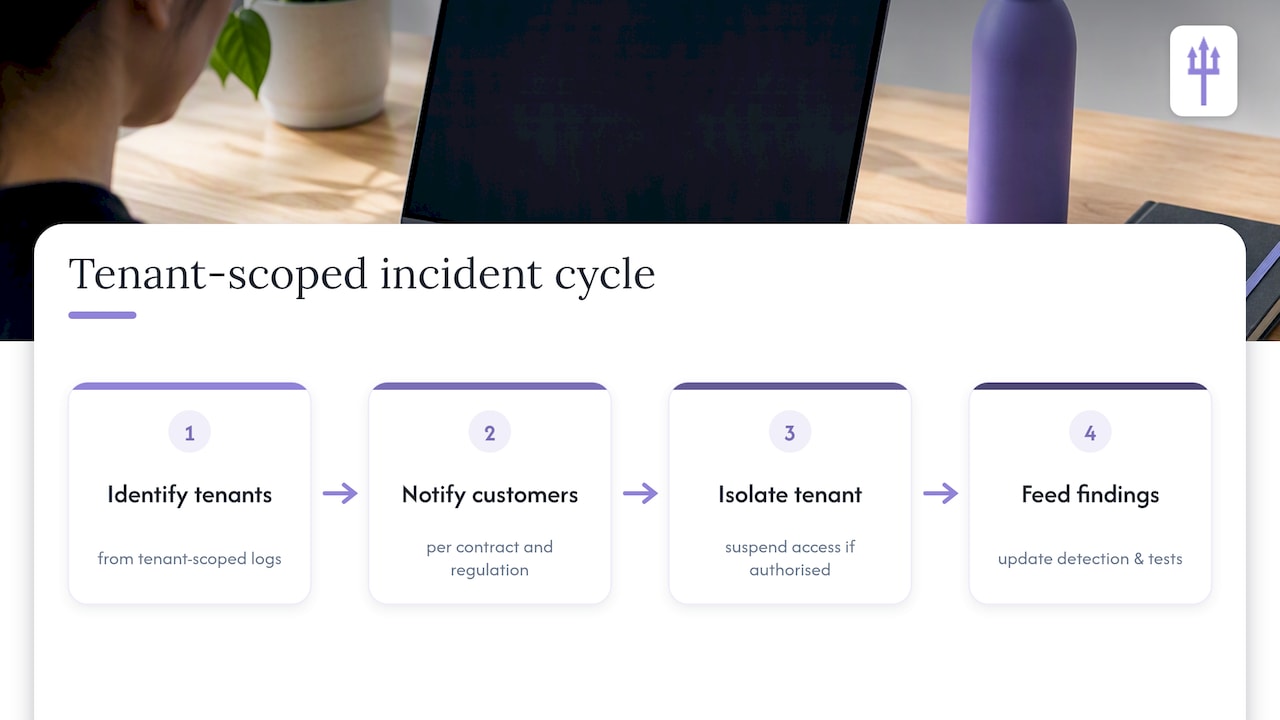
A multi-tenant incident response plan needs one capability that single-tenant plans do not: the ability to quickly determine which tenants were actually affected, rather than assuming a breach touched everyone or no one. That determination depends entirely on the tenant-scoped logging described earlier, since without a reliable tenant identifier on every log line, scoping a breach becomes guesswork under time pressure.
Build a response runbook that includes tenant notification procedures aligned with your contractual and regulatory obligations, since some customers may require breach notification within a specific window regardless of how contained the incident turns out to be. Pre-define who has authority to isolate or temporarily suspend a single tenant's access without affecting others, since the ability to contain a compromised tenant's blast radius quickly often determines how much damage an incident causes.
Practice the plan against a realistic scenario, such as a leaked API key scoped to one tenant or a suspected RLS bypass, rather than only a generic breach drill. After any real incident, feed findings back into your detection rules and your isolation tests so the same gap cannot reopen silently in a future deploy.
Compliance considerations for multi-tenant security
Multi-tenant platforms frequently serve customers under different regulatory regimes at once, which means your architecture needs to support the strictest applicable requirement rather than a lowest common denominator. Under GDPR, data subject access and deletion requests must be fulfilled per tenant without exposing or affecting other tenants' data, which argues for isolation boundaries clear enough to execute a clean per-tenant export or purge.
HIPAA-covered workloads impose their own access control and audit logging expectations, and a shared-table architecture serving healthcare tenants needs isolation and logging strong enough to support a credible audit trail for each covered entity independently. Other sectors carry their own rules, and the specific obligations always depend on where your tenants and their data are located, so treat any compliance claim as scoped to the regulation and jurisdiction that applies to a given customer rather than as a universal guarantee.
Data residency requirements compound the isolation question: some tenants may require their data to stay within a specific region, which can push you toward separate databases or dedicated infrastructure for those tenants even if the rest of your platform runs on shared, multi-tenant resources. Document which isolation model backs which compliance claim, since an auditor will ask how the architecture enforces the boundary, not just whether a policy document describes it.
Encryption strategies for multi-tenant data
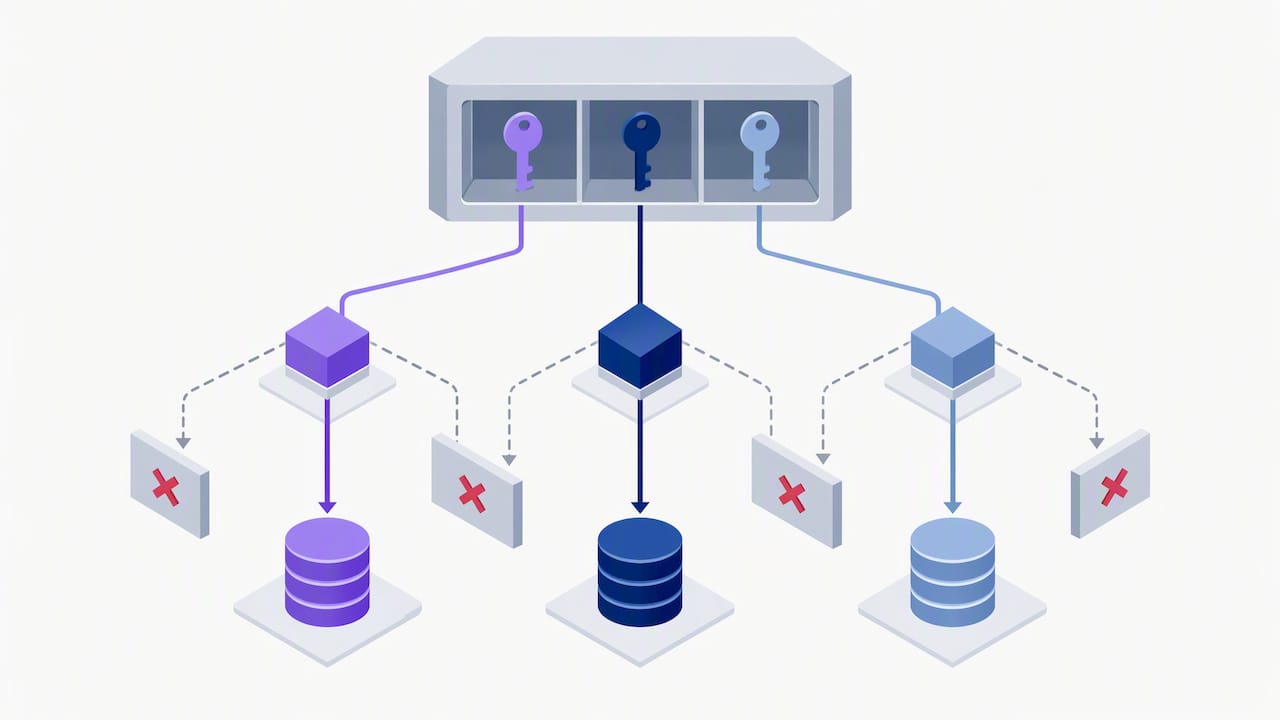
Encrypting data at rest and in transit is a baseline expectation, but multi-tenant systems raise a further question: whether tenants share an encryption key or each tenant gets its own. Per-tenant encryption keys limit the blast radius of a key compromise to a single tenant and support cleaner data destruction at offboarding, since destroying the key renders that tenant's data unreadable even if the underlying storage is not immediately wiped.
For data in transit, enforce TLS for every internal service-to-service call, not only for the public-facing edge, which aligns with the identity-first, continuously verified posture NIST's zero trust guidance describes for cloud-native, multi-cluster deployments. Encrypted transit without verified service identity still leaves room for a compromised internal service to impersonate another tenant's traffic path, so the two controls work together rather than substituting for each other.
Key management itself needs tenant-aware access control: a key management service that grants broad decrypt access to any internal service undermines the isolation that per-tenant keys were meant to provide. Scope key access the same way you scope data access, tying it to verified tenant context rather than to network location alone.
Network segmentation and micro-segmentation techniques
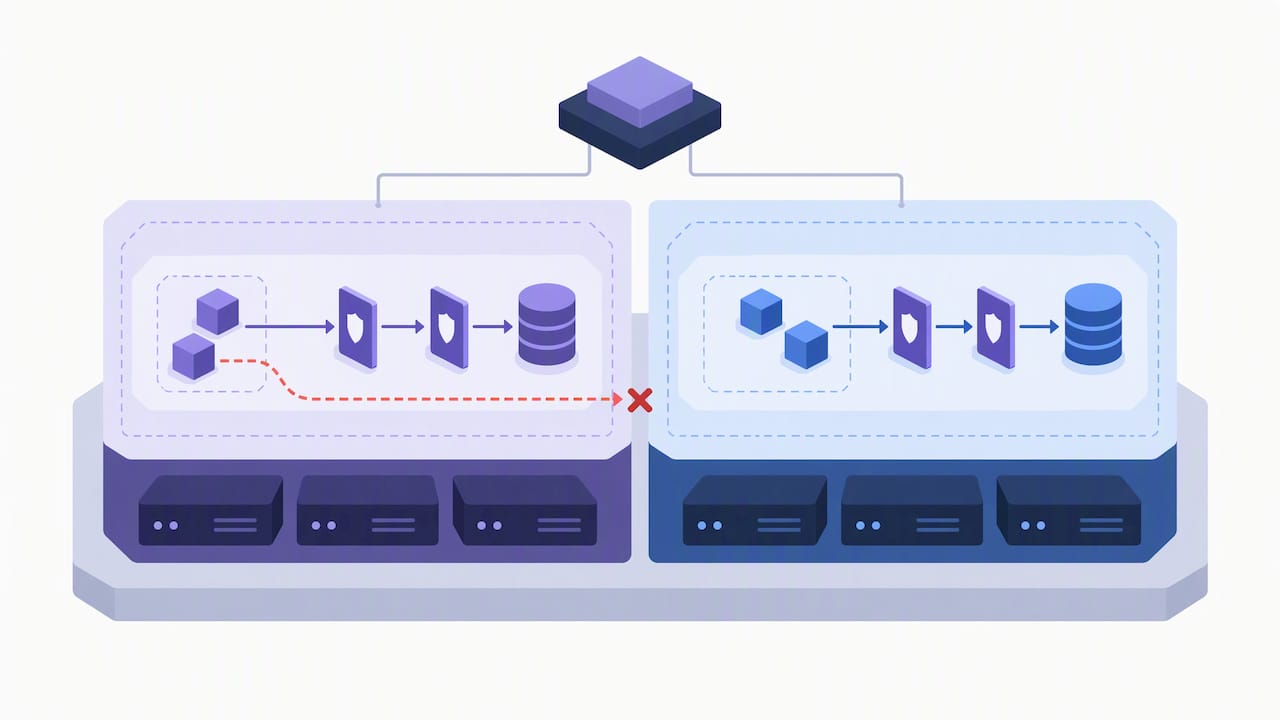
Network-level controls remain a useful defense-in-depth layer even as enforcement shifts toward identity, and segmenting at the network tier limits how far an attacker can move laterally after an initial compromise. Micro-segmentation divides the network into small, tightly scoped zones so that a compromised service in one segment cannot freely reach services or databases belonging to unrelated tenants.
NIST's zero trust model recommends combining network-tier policies with identity-tier policies rather than relying on either alone, using sidecar proxies and ingress and egress gateways to enforce both layers consistently across multi-cloud and multi-cluster environments. In practice, that means a service should be denied a network path to a tenant's database it has no legitimate business reaching, in addition to failing any identity check if it tried.
For containerized or Kubernetes-based multi-tenant platforms, namespace-level network policies and dedicated node pools for high-sensitivity tenants add a further layer, making an accidental or malicious cross-tenant network call fail at the infrastructure level even if an application bug would otherwise have allowed it.
When to bring in a security testing partner
The gaps that hurt most in multi-tenant systems are rarely the ones an automated scanner flags. Cross-tenant authorization bugs like a subtle IDOR, a misconfigured RLS policy that looks correct until a privileged connection bypasses it, or a tenant-scoped API that forgets a check on one obscure endpoint tend to require someone manually trying to break the boundary, not a signature match.
An external tester who builds an actual exploit chain, showing how one broken check leads from a low-privilege account into another tenant's data, gives you something a scan report cannot: proof the gap is real, plus a path to close it and a re-test to confirm it stayed closed. Folding that kind of review into a regular cadence, alongside automated checks in continuous delivery, catches the issues that only show up when someone tries to think like an attacker rather than a checklist.
— caleb
How we help secure multi-tenant applications
We built our testing practice to focus on gaps that can cause costly multi-tenant breaches, addressing authorization logic that automated scanners may overlook. Our web application penetration test, API and endpoint testing, and configuration and hardening audits combine automation with manual verification, so a cross-tenant IDOR or an RLS bypass gets confirmed by a human tester, not left as an unverified scanner flag.
- Every finding is verified by a tester and documented with details including reproduction steps.
- Reports include clear remediation guidance suitable for both technical and non-technical readers.
- Follow-up testing is performed to confirm identified issues have been addressed.
- Ongoing security testing options are available for teams with regular development cycles.
Review our pricing and engagement tiers, including the Starter engagement and the Retainer plan, to find the option that fits your next release cycle.
FAQ
What are the disadvantages of multi-tenancy?
Multi-tenancy concentrates risk: a single misconfigured authorization check or cache key can expose data across many customers at once, which the OWASP multi-tenant cheat sheet lists as cross-tenant leakage and noisy-neighbor risk. Shared infrastructure also means one tenant's heavy workload can degrade performance for others unless resource quotas are enforced.
What is a multi-tenant system?
A multi-tenant system is an application architecture where multiple customers, or tenants, share the same application instance and often the same underlying infrastructure while their data stays logically separated. The isolation boundary can sit at the database, schema, or row level, with row-level security being one common enforcement mechanism according to PostgreSQL's documentation.
What is multi-tenant authentication?
Multi-tenant authentication verifies a user's identity and resolves which tenant they belong to as part of that same verified process, rather than trusting a tenant identifier supplied separately by the client. Server-verified tenant context, derived from an authenticated token or session, should then be enforced at every authorization boundary in the request path.
Is multi-tenancy good?
Multi-tenancy is a sound architectural choice for most SaaS platforms because it scales efficiently and reduces infrastructure cost per customer, provided isolation controls are implemented correctly at the data, cache, and network layers. The tradeoff is operational: weak tenant context enforcement or RLS misconfiguration can turn shared infrastructure into a single point of failure for every customer at once.
Sources
- Multi Tenant Security - OWASP Cheat Sheet Series
- SP 800-207A, A Zero Trust Architecture Model for Access Control in Cloud-Native Applications in Multi-Cloud Environments | CSRC
- Protect tenants and isolate production systems — Microsoft Secure Future Initiative
- PostgreSQL: Documentation: 18: 5.9. Row Security Policies
Recommended
Want this run against your app?
Book a scanComments
No comments yet. Questions, corrections and war stories all welcome.